Should Investors Expect Slower GDP Growth? A Practical Guide
How aging populations may affect growth, rates, and long-term portfolio planning
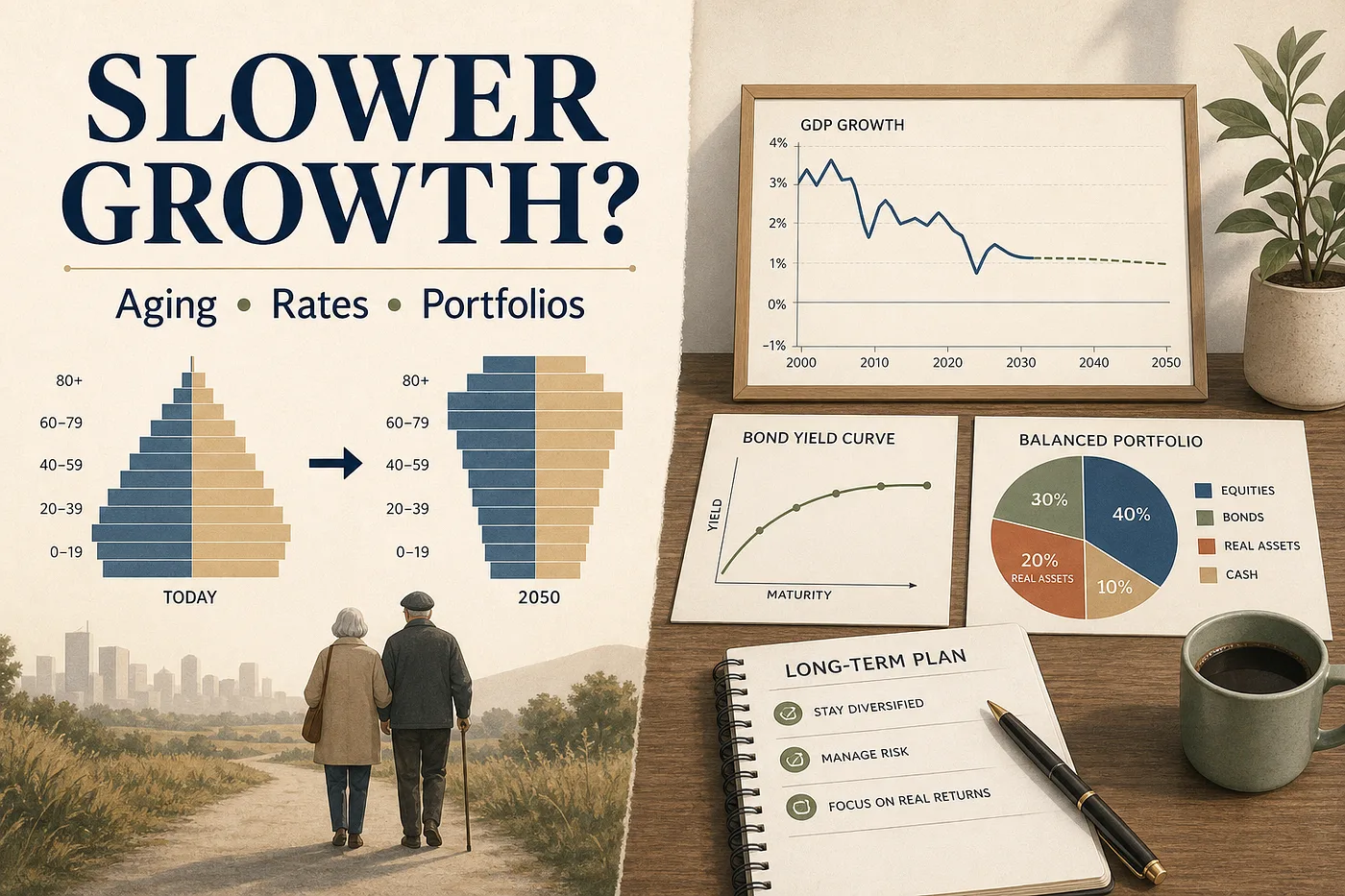
How aging populations may affect growth, rates, and long-term portfolio planning
The world is getting older. Falling fertility and longer lifespans are reshaping national age structures: the share of people 65 and older is projected to rise sharply in many economies. That is a slow-moving, predictable trend, and it matters because the size and composition of the population feed directly into how much output an economy can produce.
But there is an important distinction to make. Slower headline GDP growth is a credible and likely outcome of population aging, yet it is not the same thing as a guaranteed crash in equities or a deterministic decline in inflation. Vanguard’s research on the economics of a graying world assumes that demographics affect output through three channels, population, participation, and productivity, and that productivity remains the dominant, most unpredictable driver of long-run growth. The practical promise of this article is simple: translate the demographic signal into sensible, durable portfolio choices and retirement plans rather than panicked market timing.
Put the GDP identity front and center
A useful mental model is this: total output ≈ population × participation × productivity. Population changes alter the number of people producing and consuming. Participation measures the share of the population working. Productivity captures how much each worker produces.
Vanguard’s analysis emphasizes that historically productivity explains more of GDP growth than population or participation. That matters because demographics most directly change the first two terms and only indirectly affect productivity. In other words, fewer workers and lower participation can subtract from headline GDP growth, but firms, technologies, and institutions determine whether remaining workers become more productive and offset that drag.
Evidence from the Vanguard report shows that population growth has been a relatively small contributor to long-run GDP growth, while productivity accounts for the lion’s share of gains in countries with sustained growth. The interpretation is cautious: expect neutral to modest negative pressure on long-run GDP from aging unless productivity or migration steps in to offset the drag. The practical implication for investors is to position for a world where trend growth is lower on average, but not to assume a single deterministic path for asset returns.
How to translate the demographic signal into durable portfolio choices
Vanguard’s practical guidance is pragmatic: demographics are a long-duration background theme, not an immediate trade call. The portfolio moves that make the most sense are structural and centered on diversification, exposure to productivity growth, and managing fixed-income risk.
- Diversify globally. Home-country aging can be offset by exposure to regions with younger cohorts and different secular dynamics. Financial globalization also mutes the impact of any single country’s demographic path.
- Tilt to productivity winners. Sectors and businesses that benefit from automation, enterprise software, and healthcare innovation may gain as labor becomes scarcer and capital replaces or complements workers. This is not a short-term timing recommendation but a thematic emphasis within a diversified equity allocation. Though if one was invested in an globally diversified ETF, I would assume weighting by market capitalization to take care of that, no individual investment bets needed.
- Keep rebalancing discipline. Aging is structural and slow. Periodic rebalancing prevents drift and forces discipline when long-term secular trends gradually change portfolio betas.
These are broad principles rather than prescriptive trade instructions. The evidence supports global diversification and productivity exposure as robust responses because demographics change the playing field slowly and unevenly.
Practical steps for personal financial planning
The retirement consequences of an aging world are personal and long-term. Vanguard’s research highlights the policy responses one should expect, higher pension and healthcare spending, likely adjustments to retirement ages, and pressure on public finances. For individuals, the practical implications are several:
- Update retirement assumptions. Model longer life expectancy, lower real risk-free rates, and potentially higher healthcare and housing costs in retirement budgets. Treat these as scenario inputs rather than certainties.
- Consider work and withdrawal flexibility. Delaying full retirement, working part time, or staggering withdrawals can materially improve the sustainability of retirement income under lower expected returns.
- Stress-test savings and glidepaths. Run scenarios with lower real rates and weaker GDP growth to understand the resilience of your plan. Vanguard’s work suggests that shifting the assumptions materially changes required saving and withdrawal behavior.
- Factor in policy risk. Expect gradual policy responses, higher eligibility ages, indexation changes, or tax adjustments. Include plausible policy shifts in long-range cash-flow planning.
- Evaluate income and insurance solutions conservatively. Income products such as annuities and long-term-care insurance can offer stability, but they should be evaluated for costs, terms, and how they fit your broader plan rather than as blanket recommendations.
None of this is legal or individualized financial advice. The point is to be realistic about uncertainty and to design plans that are robust to lower long-term returns and changing public policy.
What to monitor, a short checklist
Track a few slow-moving indicators and update scenarios when they deviate materially from base expectations:
- Fertility rates and net migration flows
- Participation rates, especially 55+ and prime-age cohorts
- Productivity growth (output per worker or TFP proxies)
- Policy moves affecting public pensions and retirement eligibility
- Signs of accelerated automation
Red flags include a persistent collapse in productivity with rising dependency ratios; that scenario would imply deeper growth drag. Opportunities arise when labor scarcity pushes companies into sustained productivity investments, lifting returns in capital- and technology-intensive sectors.
A measured closing
Demographics will probably slow headline GDP growth modestly on average, but they are not destiny. Productivity, institutions, migration, and policy matter far more for asset returns and living standards than age structure by itself. For investors and planners the sensible course is humility: assume a lower-rate backdrop, diversify globally, favor durable exposure to productivity growth, and design retirement plans that are robust to lower returns and higher longevity. Treat aging as a persistent background theme, important for strategy, but not a trigger for panic.
📩 Join Investor’s Handbook Digest — get the best investing, markets, and wealth-building insights each week.