Investing Course for Intermediates with Checklist | Part 1 | Introduction
This article was originally published on YouTube Introduction In this investing crash course, I want to briefly go over everything you need to know, to finally start investing. Also, I want to provide you with a checklist at the end you can reference, each time when in doubt…
Updated
This article was originally published on YouTube
Introduction
In this investing crash course, I want to briefly go over everything you need to know, to finally start investing. Also, I want to provide you with a checklist at the end you can reference, each time when in doubt in the future. Science based investing for private investors is no witchcraft anymore. The genie is out of the bottle, you can find everything you need to know about investing on the internet for free, a plethora of guides, books and videos at your fingertips. But with all the information out there, it can be hard to keep an overview of every little thing you are supposed to remember and pay attention to.
If only there was a maintained checklist online that did just that. It’s actually hard being useful in the online finance education space, as the important basics are already so well-known and covered by at least a bazillion people. But I do think a comprehensive up to date science-based checklist condensing all this information would have merit, so that’s why I am going through the trouble of creating this guide.
Scientific basis for most of the guide will be Burton G. Malkiel´s “A Random Walk Down Wall Street (Completely Revised and Updated)” 15, Edition from 2024 and Gerd Kommer´s “Souverän investieren mit Indexfonds und ETFs — Ein Investmentbuch für fortgeschrittene Privatanleger” 7. Edition from 2025 which translates in English to “Investing confidently with index funds and ETFs — An investment book for advanced private investors”. If I mention the book in the future, I will do it under its abbreviated German title “Souverän Investieren” (Investing confidently). The reason I will mostly draw from these two books is, that, “A Random Walk Down Wall Street” is considered by many the go to book for investing for English speakers, while “Souverän Investieren” is the pendant for German speakers.
I will probably mostly cite Kommer, as I feel like his book applies a little more scientific rigor compared to Malkiel. In addition, Kommer, as far as I am aware only publishes his books in German, while also including a lot of statistics, information and arguments you would not find in “A Random Walk Down Wallstreet”. In this way, I might be able to treat you to some information nuggets you would not be able to find otherwise. Please let me know if there is a specific topic you are interested in, we can cover these in one of the future chapters. So without further ado, let’s get the party started.
ETF investing is where it’s at
If you have not been living under a rock for the last 10 years, you should already know that a passive investing strategy with ETFs is the way to go nowadays. This fact is repeated online so often now, that it can be easy to forget why that is actually the case. The most important core message of books like “A Random Walk Down Wall Street” or “Souverän Investieren” boil down to the recommendation to implement a passive, long-term investing strategy with low-cost diversified ETFs. Most important exception to this advice would be, that it can also make sense to invest into buying or building your own home, if you plan to live in it long-term and other factors and considerations are met. This guide will assume, that you are not thinking of buying a house anytime soon or at all. If it makes more sense to buy or rent is an interesting scientific discussion to be had for sure, and if there are people interested in it, I can certainly cover this topic in a future chapter.
“A Random Walk Down Wallstreet” is already on its 15. Edition, while “Souverän Investieren” now on its 7. Edition. Both written by well-known finance experts in the field, that made it their life’s mission to teach this very topic. Trying their best to improve their carefully crafted texts even further with each edition. I simply cannot hope to rival them in teaching passive investing fundamentals with the same scientific rigor, wit and depth. I can however strongly recommend everyone that wants to gain a deeper understanding of the scientific ins and outs of passive investing to read or listen to either one of these works. They will not be able to teach you everything you need to know about investing, but the foundation they will lay, will be so solid, that most private investors will have trouble coming up with a convincing reason why they would need to read another finance book during their life time, except of course, simple interest and pleasure in finance literature.
While the bounded books, eBooks and audiobook versions could be pricier than what you are used to in spending for a single book, the dividends a solid grasp of investing fundamentals will pay these over and over again. Furthermore, both books will probably also be available for free during an audible trial or the usual price of the monthly audible fee in your country. And of course, while I definitely recommend supporting these works by directly buying them, if you are not able to do so with your financial situation right now, you could also always try your luck on the high seas. I know many will be hesitant to actually follow through with consuming on of these books. Considers this, the audiobook for “A Random Walk Down Wallstreet” is 13 hours and 14 minutes long, around 12 hours if you skip the epilogue and end credits. As the narration speed leans on the slower side, I think most people should be able to still comfortably listen to it at 1,2x speed, reducing it further to around 10 hours.
You could just listen to 1 hour of the audiobook every day, and still have 4 days in the second week to skim this guide and doing some additional research, for any tax specifics in your country et cetera. And after these 2 weeks, you will have a science based, investing strategy ready to be implement and know more about investing than probably 98 percent of people will ever know. I still totally expect nearly everyone not to be bothered by doing the reading, but hey, at least I tried. And for everyone that ended up reading and needs a small recap, and of course also everyone that could not be arsed, the following paragraph will be my best effort attempt at summarizing the core reasoning of these books, why passive investing with ETFs is the way to go for most private investors.
The stock market used to be fun
The stock market was not always as efficient as it is today, you could even say the stock market was fun once upon a time. When Buffet started investing in 1942 and some decades after that, he used to be able to go through dozens of balance sheets of companies and from time to time, he would be able to notice something interesting. For example, that a company would be on sale, but for less than the value of selling of piece by piece. In a case like this, Buffet could swoop in, buy the company and make a good profit with decent margin of safety. Good investments did not always mean selling off the company though, it could also mean that he found stocks for purchase that we most likely undervalued by the market. As Buffets assets grew more and more, like a rolling snowball, he was able to do something even more interesting, that is not usually part of a fund managers job.
At some point, he was not just able to just buy some stock, he would be able to buy a shareholder majority or outright buy entire companies. This enabled him to change company direction and strategy, if he spotted an opportunity to increase profits through that, he could also find and utilize synergies between his companies. In this sense, Buffet was not only a fund manager and investor, but also entrepreneur. These were the times when “The Intelligent Investor” was published Benjamin Graham, teaching value investing basics. He wrote and published this book, because back in the days, the stuff worked. Buffet and colleagues were able to use these principles to make a shit ton of money and get above average stock market returns. The stock market was a worthwhile fulltime occupation, the next big investment hidden in the printed balance sheets of companies big and small, if only you knew how to spot them reliably.
And the practice of value investing was only one of many flavors you could utilize to make money of the prevalent market inefficiencies. It was like the Wild West and Gold Rush all over again. And if you did not have the inclination or just not the interest in becoming a fulltime investor yourself, it could have made sense to hire a financial advisor. Of course they would offer their services for a decent fee, but who cared if they outperformed the market and earned their fees and more? Of course, under the presumption you had the luck to end up with a financial advisor or hedge fund manager who knew what they were doing.
You might wonder now though, if it was so easy to make a fortune by investing in the stock market, why would not just everybody do it, everyone would be rich. It’s not so much that literally everyone started to invest in the stock market, but the finance sector evolved, getting more efficient every year, new technologies emerged, making the flow of financial information faster and faster. After all, if you leave breadcrumbs on the table, expect them to be eaten up, especially when you are dealing with hungry wolfs, like the finance bros from Wall of Wallstreet. And even investing coryphées like Buffet started to notice. Already in 1967, Buffet considered changing careers, as he found it hard to find good value investments during the bull market. It is interesting to notice, if you read his biography, that going forward into the next decades, he does complain about the fact that it got harder and harder to beat the market, to find good investments and market inefficiencies to profit from. He acknowledges the fact, that investing is not the same anymore, as it used to be during his youth.
The Efficient Market Hypothesis
Interestingly enough, just 2 years before Buffet admitted having problems finding opportunities to outperform the market, Eugene Fama introduced the efficient-market hypothesis in his paper “The Behavior of Stock-Market Prices”, that was part of his PhD. (Britannica Money, 2025; Fama, 1965) The paper does not directly use the term efficient-market hypothesis, but rather describes the concept as, “…a situation where successive price changes are independent is consistent with the existence of an ´efficient` market for securities, that is, a market where, given the available information, actual prices at every point in time represent very good estimates of intrinsic value”. (Fama, 1965, p. 90)
In 1970 he formalized this idea in his paper “Efficient Capital Markets: A Review of Theory and Empirical Work” as, “A market in which prices always ´fully reflect` available information is called efficient”. (Fama, 1970, p. 383) He tests the hypothesis for different forms: “First, weak form tests, in which the information set is just historical prices, are discussed. Then semi-strong form tests, in which the concern is whether prices efficiently adjust to other information that is obviously publicly available (e.g., announcements of annual earnings, stock splits, etc.) are considered. Finally, strong form tests concerned with whether given investors or groups have monopolistic access to any information relevant for price formation are reviewed.” (Fama, 1970, p. 383) He concluded that, “with but a few exceptions, the efficient markets model stands up well.” (Fama, 1970, p. 383)
Shocking underperformance of active funds
The first to implement this theory of efficient-market hypothesis into a large-scale financial product was John Bogle. He founded The Vanguard Group in 1974 and only a year later introduced the first index mutual fund, which was coined “Bogle´s Folly” and unamerican, because it merely tried to track the market return, a passive investing approach. While Vanguards investment funds did take a long time to find willing investors, they did not turn out to be the folly their critics made them out to be.
While the public needed sometime to wrap their head around this unexpected result, the passive investing approach implemented by Vanguard simply worked. Let’s have a look at some convincing data from “Souverän Investieren”. In his second chapter, he summarizes the data from S&P Dow Jones Indices »SPIVA Europe Scorecard Year End 2022« in a table for actively managed investment fonds in Europe. After 10 years, 96% of funds investing in developing countries and 98% of funds investing into developed countries underperformed their benchmark. (Kommer, 2025, p. 27) Furthermore, the data does not include associated costs, which would most likely increase the percentages of underperformance even more. Additionally, most people interested in investing will have an investment horizon longer than 20 years, where we would also expect an even higher percentage of underperformance.
To summarize this, in the long term, nearly 100% of actively managed funds seem to underperform their correctly chosen benchmark. To make matters for actively managed funds even worse, the underperformance on average is not neglectable, but after 10 years more than 2% per annum for developing countries and for developed countries nearly 4%. (Kommer, 2025, p. 28)
Performance Consistency
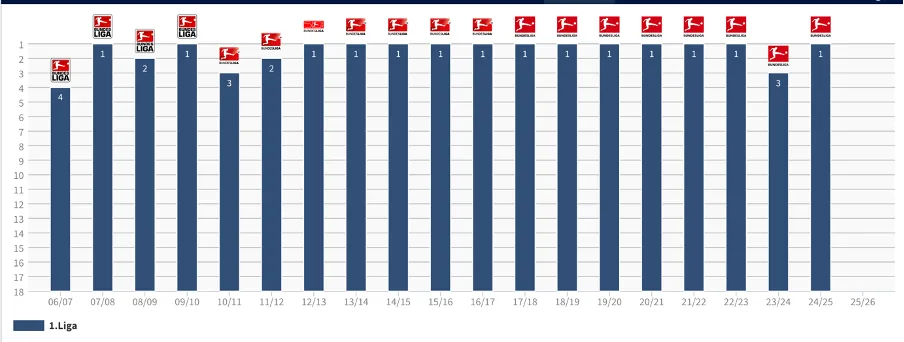
In response you might say, of course from all the available active managed funds, the bad performing fund manager will drag down the average. But that is no concern for you, you´ve done your research, the manager you selected knows what he´s doing, and will surely do much better than average. If we assume, that there are good and bad performing managers, we could expect to see the same managers in the top 25% over and over again. Consider this analogy to football leagues and world cups. We cannot expect the same team place first every year, not even the best of the best. And there will be some variation to the results and some weird years in between, where placement is way different than expected. But in general, while Bayern might not win the Bundesliga every year, they consistently place high on the list.
That is because the team has a certain performance consistency. The established players, managers, training culture, financing give them a clear advantage to place better than the teams at the bottom. Large part of their performance can be attributed to what they bring to the table, not sheer luck. Of course, if they win the championship this or next year can depend on lucky goals or penalties, but that’s why we are flexible with the benchmark and only set it to the upper 25%. While I choose the example with Bayern München just for fun, it actually holds true. For the last 20 years, they have not performed worse than 4. place in the first Bundesliga out of 18 teams. (FC Bayern München — Historische Ligaplatzierungen, 2025)
But which horrors await us, when we look at the statistics for active fund managers. Kommer looks at the percentage of fund managers, that stay in the upper 25% after only 5 years, and find 0% for developing countries, and a mere 0,4% for developed countries. With a clear downtrend in the percentages, one would assume that the percentage for developed countries would also drop to 0%, if only the chosen time frame was a little longer.
It’s as if their performance was not because of their skill, like in football, but mostly sheer luck. And Kommer comes to this sentiment in his book as well later on. To recap the numbers we just went over, around 100% of active funds underperform in the long run, the underperformance will probably be substantial, and we can also not really get lucky while choosing, because the performance of the manager in and off itself is based on luck.
Lottery but worse
It’s like playing lottery, only investing into actively managed funds is even stupider, as in the long run, none of the investor’s seem to win . Except of course the fund managers, and associated institutions, as they will collect their fees no matter their performance. Of course they would also prefer to perform well, as that would also increase their collected fees and bring in new customers. And surely most fund managers are very capable and hard working. But at the end of the day, at least this is what our current understanding of the stock market heavily suggests, a single person or team does not hold a candle to the predictive power of the entire stock market system. This also explains in part the bad underperformance. Fund managers, like every other profession need to be paid. They are getting paid by the fees they charge on their funds. But here is the big catch, compared to almost every other job there is, their work seems to not create any value at all.
You could even argue their work is more harmful to their customers than useful. But compared to low-cost ETFs, the high fees cut into their performance every year. In the first year, the additional fees might be “only” 1 or 2 percent, but after 30 years, that can accumulate to a much bigger percentage. Even our value investing prodigy Warren Buffet, recommends now that most people invest into an ETF, instead of stock picking. (CNBC, 2020)
Exceptions apply seldomly
Of course, let’s say you are a politician in America, have access to insider information on which legislation is about to pass in the next few days and how that will likely affect the stock market, that’s a different story. Then normally, you still would not be allowed to use that information to your own advantage, as that would be insider trading. But for example, in America, even after the disastrous financial crisis in 2008, consequences for this political insider trading are so low, that still some politicians seem to be doing it. I also do not want to argue, that it is virtually impossible to outperform the market based on skill, but that the sentiment holds true for the normal average investors. If you are reading this article and happen to be the president of America or have a PhD in finance and are leading a banking team using the latest super computers and algorithms with information not available to the general public, or similar, then in fact, different rules might apply to you.
Still, I already hear the active trading proponents objecting from the back, that the data used by Kommer is only for European funds. The thing is, the outperformance of the passive investing approach has been cemented by a multitude of research findings, with data from all over the world, over the last decades, repeatedly, in theoretical and empirical works. I won’t bore you by listing or going through each of them all. I would also be lying if I said I know, read or understood all of them. What I can say with confidence though, is that if you look at what they teach at the universities, what the trustworthy and knowledgeable researchers, authors, YouTubers, Redditors, bloggers etc. all have to say about the topic, it all points to the same conclusion. I think I could also just say, it’s the scientific consensus at the moment. Of course, there are also a lot of influencers preaching the total opposite of what I am writing here. But I also said trustworthy and knowledgeable. Chances are, and I´m sorry to say that influencers advocating for active trading strategies are most of the time neither, while sometimes missing only one of the mentioned qualities.
What about DIY?
Next objection, you might come up with. The data is only about professional active funds and managers, surely you could do better as a private investor. While we also have data and tables on that, I won’t even bother to quote. Just think about it for a second, active fund managers are most of the time smart people, doing this fulltime. Surely, you can do better than them, much better actually. You just need to be really lucky. Go 100% into Amazon, Apple, Tesla or what have you, and you might outperform the average stock market and active manager by a factor of 10 or more. Easy, not even breaking a sweat. Thing is, if that happens, you are just a lucky, but not suddenly a stock market genius showing investing skills that no active fund manager was able to display in the last 2 decades. If you think you can do better than professional fund managers by merit of skill, you are kidding yourself.
Diversification is king
Which would beck yet another question, why do active funds and passive funds alike hold back their best performing assets, by investing in so many different stocks at the same time? Investing into many different titles is called diversification. Without going too much into portfolio theory, we want to maximize diversification as much as possible, if more diversification does not come at prohibitive cost. If we invest into stocks, we earn their higher long term average returns compared to safer investments, for example triple A bonds, by shouldering the additional risk and volatility of the stocks. Each individual stock has a certain volatility associated with it. If we combine different stocks with the same average return but not 100% correlated volatility, the resulting portfolio will have lower volatility while having the same average returns.
If we combine all stocks and weigh them by market capitalization, we minimize volatility as much as we can, while also investing into stocks. We basically shoot for the average asset class return. If we invest in an asset, we only get rewarded by carrying the risk inherent to that market or asset class. Because if you have a portfolio with higher volatility than the market average, you can eliminate that additional risk by more diversification. The market does not need or will reward you, for carrying unnecessary risk. As investors, we don’t like unnecessary risk or volatility, therefore we want to maximize diversification, until more diversification becomes cost prohibitive.
Why stocks in the first place?
If you are getting frustrated by all this stock market portfolio theory, you might wonder how we ended up focusing so much on stocks and their specific asset risk in the first place anyway. The major asset classes we have a lot of historical data on are stocks, real estate, bonds, money market (saving books/accounts), gold and commodities (spot market). (Kommer, 2025, p. 17) Other more exotic asset classes like art, old cars etc. are to be considered more in the realm of speculation than serious investing. Of course, if you are an expert in the field, perhaps you can spot great investment opportunities than no one else can. But probably you are just speculating. The available data and scientific work for these more obscure asset classes does not compare to the big established asset classes and makes educated scientific predictions about their expected long term returns harder.
Chances are, you will always find a buyer with reasonable transaction costs for stocks, bonds etc., but who knows if anybody will still care in 40 years about the limited Pokémon booster packs and Lego builds you have hidden in your attic. Similar goes for crypto currencies and other new asset classes, with the additional problem that we simply do not have enough historical data for reliable scientific evaluations. With crypto currencies, that might change in the future, as we get more data and scientific papers on the topic. For now, you could perhaps consider adding a small percentage of crypto currencies to your portfolio in the name of diversification, but it cannot be recommended to be your main investing vehicle. And even then, I would be surprised if this recommendation would change drastically in the next few decades.
So then, for the historical long-term returns without inflation, 124 years from 1900–2023, Kommer found the following returns per annum: 5,1% for stocks, 2,4% for real estate, 1,8% for bonds, 0,5% for gold and 0,3% for commodities. (Kommer, 2025, p. 27) There are a lot of scientific debates to be had how and why the returns of the asset classes are as they are. But for an investing crash course, it should be enough to note down, in the long-term, stocks are the most volatile asset class, but they also have the highest expected return. Who knows, maybe that could change in the future, but to my knowledge, there is no convincing argument why we should believe that to happen with a high likelihood.
ETFs — The better index funds
So, what about ETFs? For now, I just mentioned that Vanguard setup an investment fund. While index funds can only be traded once per day, that is not the case with ETFs. (ETF Vs. Index Fund: What’s the Difference? | Fidelity, 2024) ETF stands for “Exchange Traded Fund” and can be bought and sold around the day, just like stocks. They are similar to index funds in that they are investment vehicles that are normally used to hold different stocks or assets combined under one investment. You could think of ETFs as a more modern version of the index fund. It is just a fund you can trade at the exchange. Nowadays, ETFs are often used interchangeably with the passive investing approach, as they are the most useful investment vehicle for that purpose right now. Investment funds are associated more with managers and active trading. But pay attention, index funds and ETFs are just investment vehicles. Either finance product could use an active or passive investment approach.
TL;DR
To recap, we want to implement a passive investing approach, by utilizing an ETF. In the next chapter, we going to talk about choosing an asset allocation for our portfolio and later on the specifics on how to choose an ETF and broker.
- Implement passive investing approach by using ETFs
Outro
Thank you very much for taking the time and reading my article. If you have any questions regarding the article or investing in general, feel free to ask. I will try to answer your questions if I can or cover topics in the future you are interested in. Also happy to receive criticism, hints for typos and suggestions how to improve the article for future iterations. You can also follow me on LinkedIn.
References
Britannica Money. (2025, June 5). https://www.britannica.com/money/what-is-the-efficient-market-hypothesis
CNBC. (2020). Warren Buffett: For most people, the best thing is to do is owning the S&P 500 index fund. https://www.cnbc.com/video/2020/05/04/warren-buffett-investing-advice.html
ETF vs. index fund: What’s the difference? | Fidelity. (2024). https://www.fidelity.com/learning-center/smart-money/etf-vs-index-fund
Fama, E. F. (1965). The Behavior of Stock-Market Prices. The Journal of Business, 38(1), 34–105. http://www.jstor.org/stable/2350752
Fama, E. F. (1970). Efficient Capital Markets: A Review of Theory and Empirical Work. The Journal of Finance, 25(2), 383. https://doi.org/10.2307/2325486
FC Bayern München — Historische Ligaplatzierungen. (2025, June 11). https://www.transfermarkt.de/fc-bayern-munchen/platzierungen/verein/27
Kommer, G. (2025). Souverän investieren mit Indexfonds und ETFs: Ein Investmentbuch für fortgeschrittene Privatanleger (7., aktualisierte Auflage). Campus Verlag.